 TuckBook
Bedtime stories
TuckBook
Bedtime stories
The Silver-Nosed Hedgehog
Wisp turns a rainy afternoon indoors into a brave expedition, building a blanket camp and discovering that rain can be a friendly river. With pillows, biscuits, and a captured sunbeam, he makes his little campsite ready for the next adventure.
✦ Story pages
8 minutes of reading
The Silver-Nosed Hedgehog
1 / 7
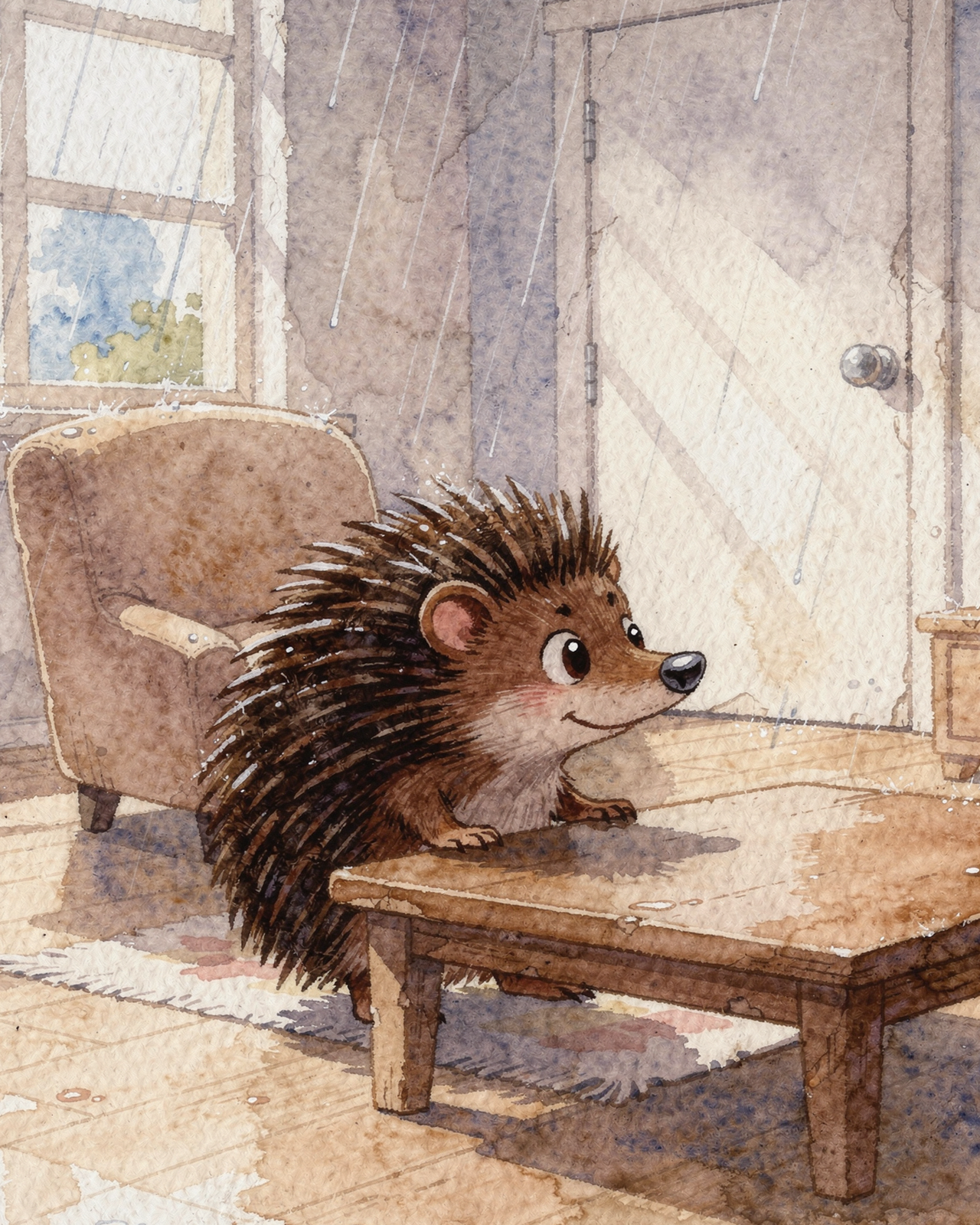
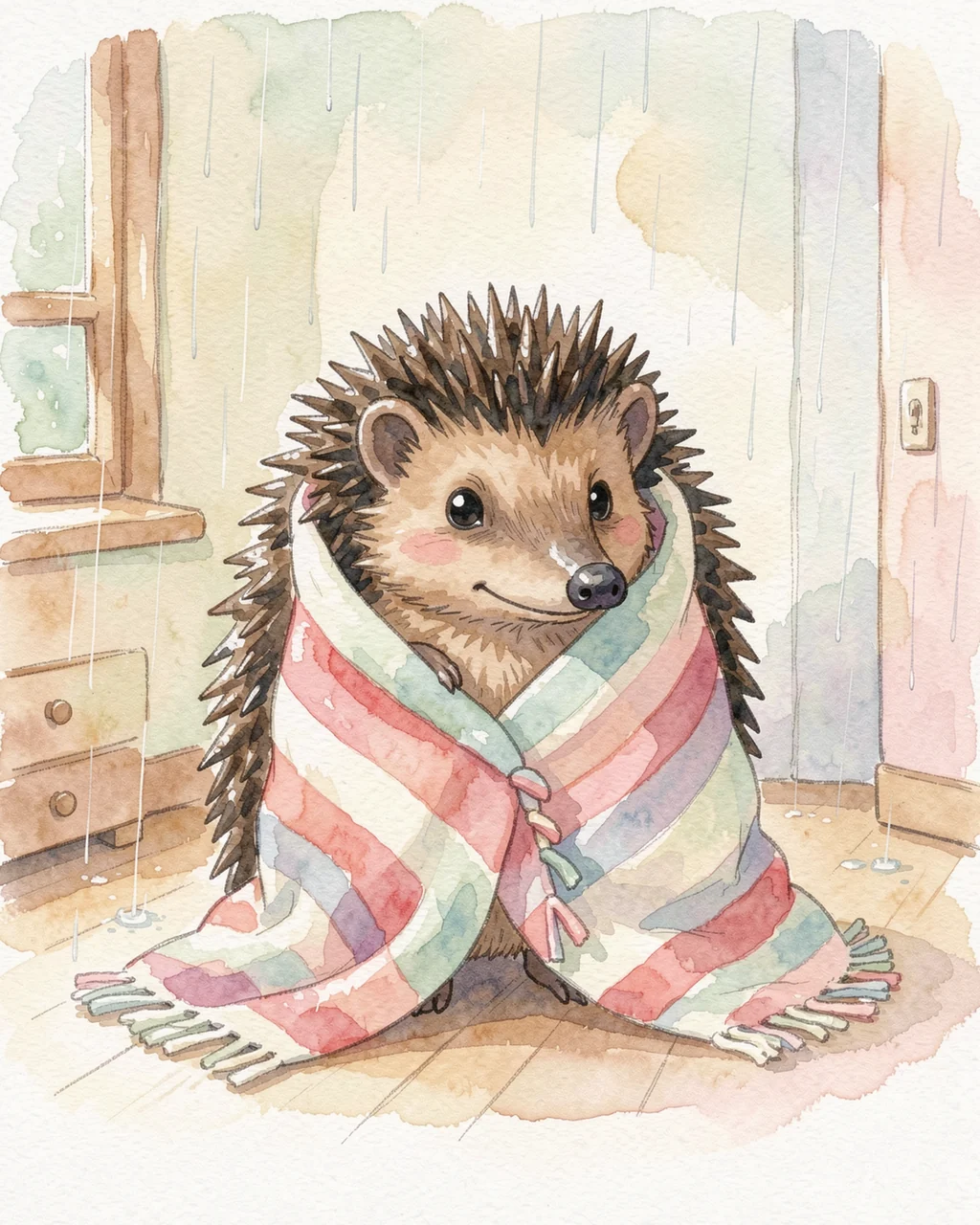
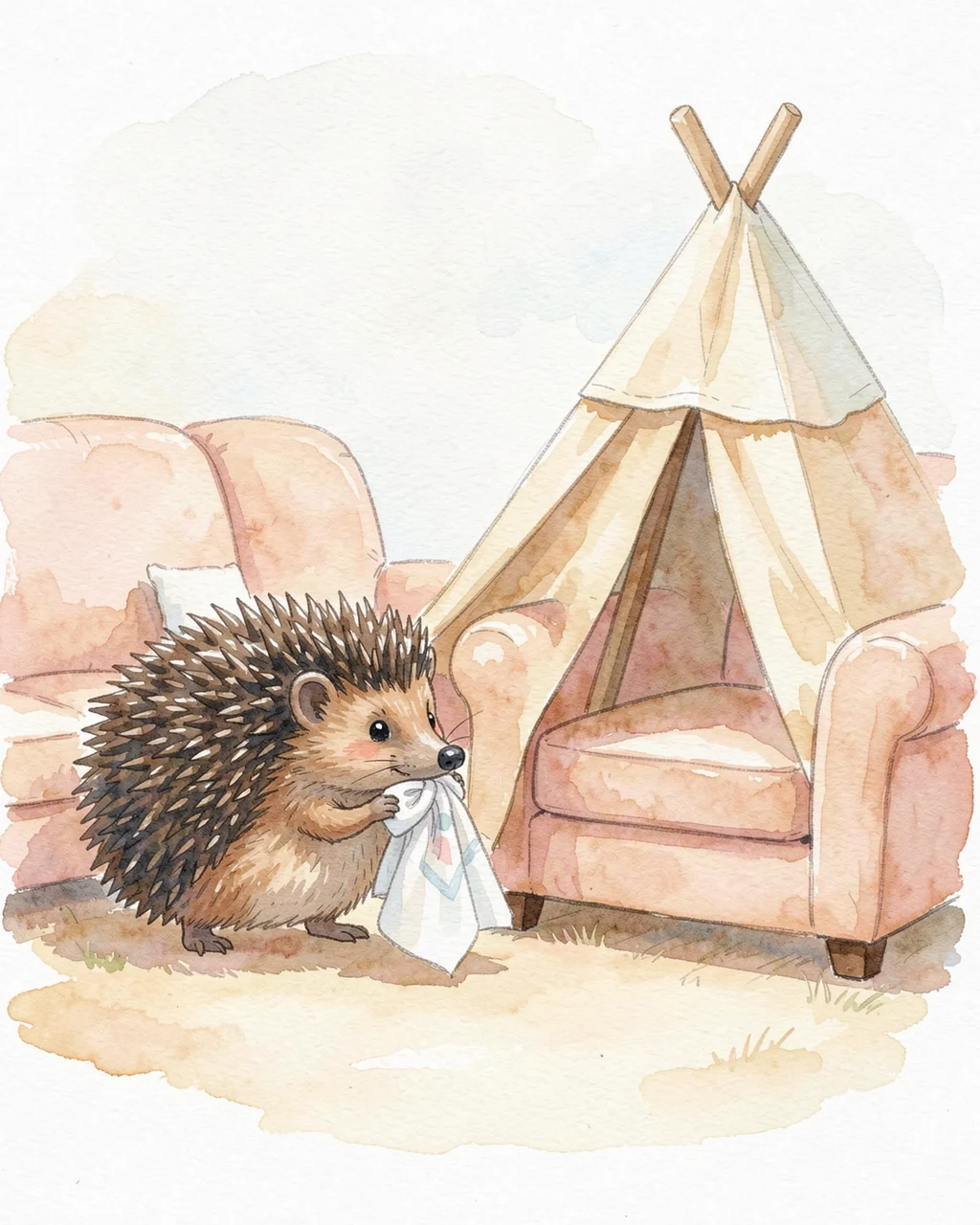
Wisp shoved the corner of a striped blanket beneath the leg of the armchair and stepped back. The blanket slid out at once, flumped over his head, and wrapped him up like a very prickly sausage. “That,” said Wisp from inside it, “is not a tent.” His silver nose poked free just as rain drummed hard against the window. He wanted an indoor expedition before the afternoon was gone, with a tent, a camp, and perhaps a dangerous river made of the blue rug.
Wisp was a small brown hedgehog, and the room was enormous in the useful way rooms can be when you are small. The armchair made a cliff. The low table made a mountain shelf. The rainy window was a whole gray sky, streaked with silver drops that raced each other down the glass. But every plink, plunk, rattle, and splatter of rain sounded as if a giant was dropping spoons onto the roof.
2 / 7
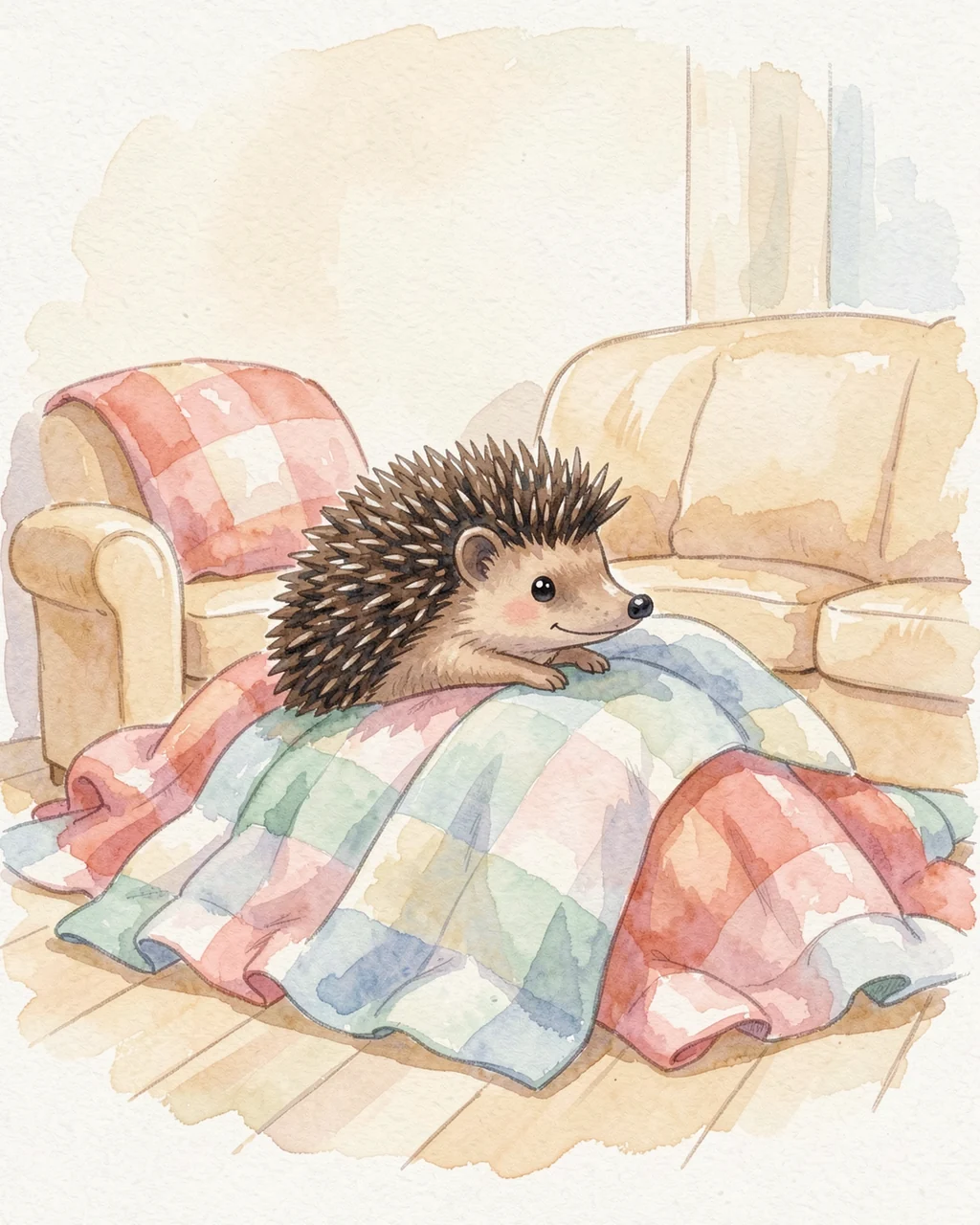
He tried again. This time he stretched one blanket from the armchair to the sofa, then balanced the other across it. Wisp held the bottom edge with both paws and waited. The top blanket sagged. It sagged farther. It gave one polite little sigh and landed squarely on him. The tent was now a lumpy hill, and Wisp was its grumpy secret.
He wriggled out and looked at the rain. “You are being much too loud,” he told the window. Rain answered, RAT-A-TAT-TAT, on the pane. Wisp’s prickles lifted. A proper explorer did not need silence, he supposed. Still, an expedition ought to feel safe enough for eating three crumbly oat biscuits without worrying that the sky would barge in.
3 / 7
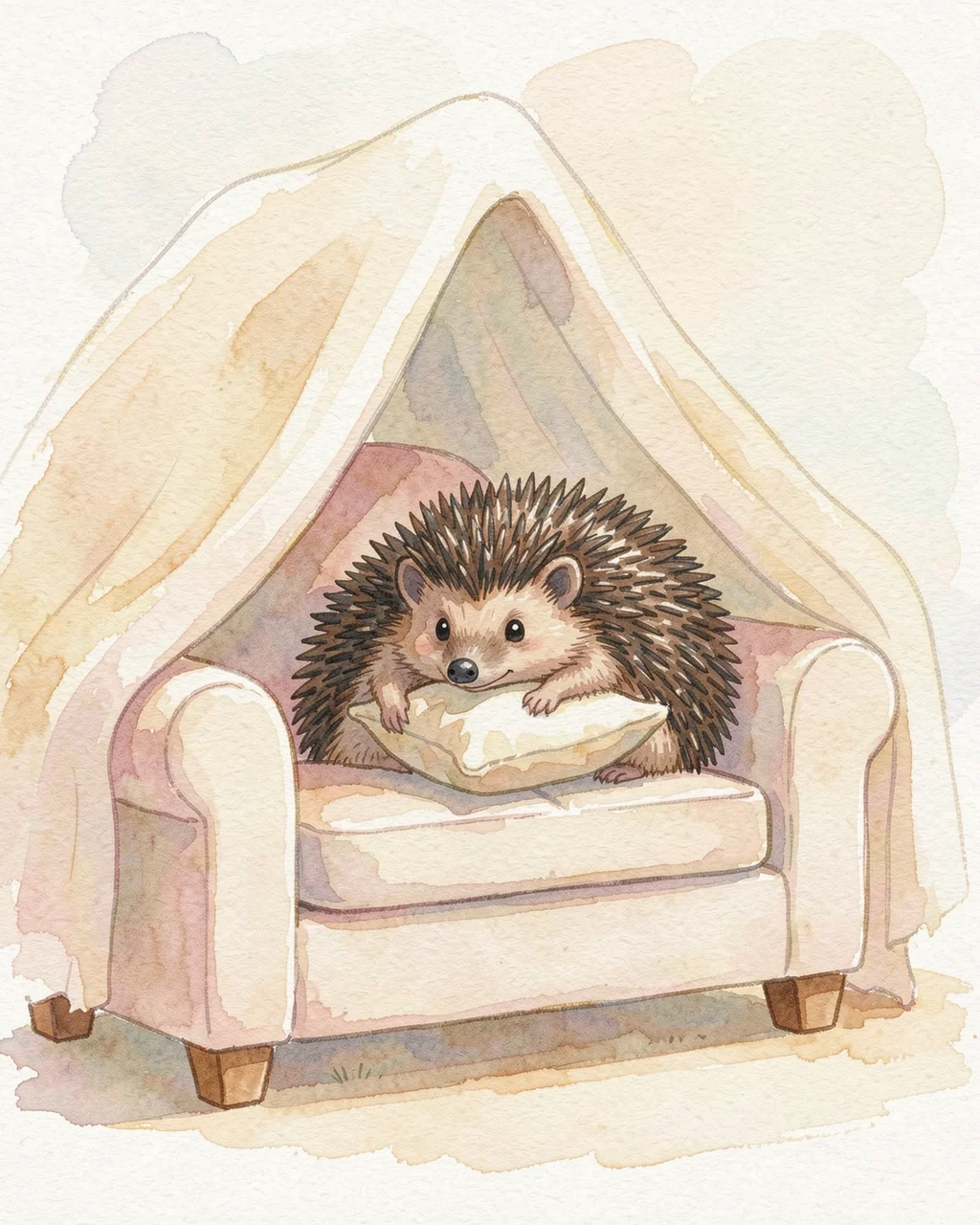
Then he spotted the sofa pillows, piled near the armchair like fat sleeping turtles. Wisp tugged the smallest one across the rug, pushing with his shoulder and pulling with his paws whenever it rolled away. He wedged it under the blanket’s droopy middle. Then he fetched a second pillow and tucked it behind the first. The blanket stayed up, not perfectly, but bravely.
“Tent poles!” Wisp announced. He crawled beneath the patchy roof. It smelled faintly of wool and cinnamon toast. Rain still hammered the window, yet the pillows made a soft wall between its noise and his ears. He placed one oat biscuit on a saucer just inside the entrance. This was clearly the camp kitchen. The other two biscuits went into a folded handkerchief for emergencies.
An expedition needed a lamp, so Wisp hurried to the low cupboard and found the old brass flashlight that kept daylight in its round glass belly. It had no buttons or wires, only a little sunbeam caught long ago for cloudy days. Wisp carried it carefully by its handle and set it on an upside-down bowl. Golden light filled the tent, turning the blanket stripes into tall trees.
4 / 7
Now the blue rug became a lake, the tassels along its edge became reeds, and the armchair cliff grew shadowy caves beneath its arms. Wisp found a square of paper beside the drawing pencils. With a green pencil gripped firmly in his paw, he drew a crooked trail from the tent to the biscuit kitchen, around Pillow Peak, across Rug River, and up to the rainy window. At the window he drew a large question mark with boots.
The moment he pinned the pretend map to a pillow with a wooden clothes peg, the flashlight beam gave a flicker. The striped trees seemed to sway. From beyond the tent entrance came a whispery rush: shhhhhh, shhhhhh. Wisp peered out. The rain had made a stream on the windowpane, and it curved exactly like his green trail. A round drop paused at the bottom, as if it were waiting for instructions.
“Are you following my map?” Wisp asked. The drop trembled, then joined another drop. Together they slid down, fast and bright, to the painted question mark. RAT-A-TAT-TAT! cried the rain. Wisp understood. The rain was not trying to break into camp. It wanted to be the river, the distant waterfall, the sound of a thousand tiny explorers marching through leaves.
5 / 7
Just then the blanket roof sagged again. One pillow began squishing sideways, and the flashlight beam tipped toward the biscuit saucer. Wisp could crawl out, fold everything away, and let the noisy rain win. Instead, he caught the bowl before it rolled, set the flashlight safely on the floor, and studied his map. “A campsite needs a bridge,” he said. He pulled the sturdy handkerchief from his emergency biscuits and stretched it from the sofa edge to the armchair leg. Then he tucked the loose blanket corner beneath the handkerchief and piled both pillows against it.
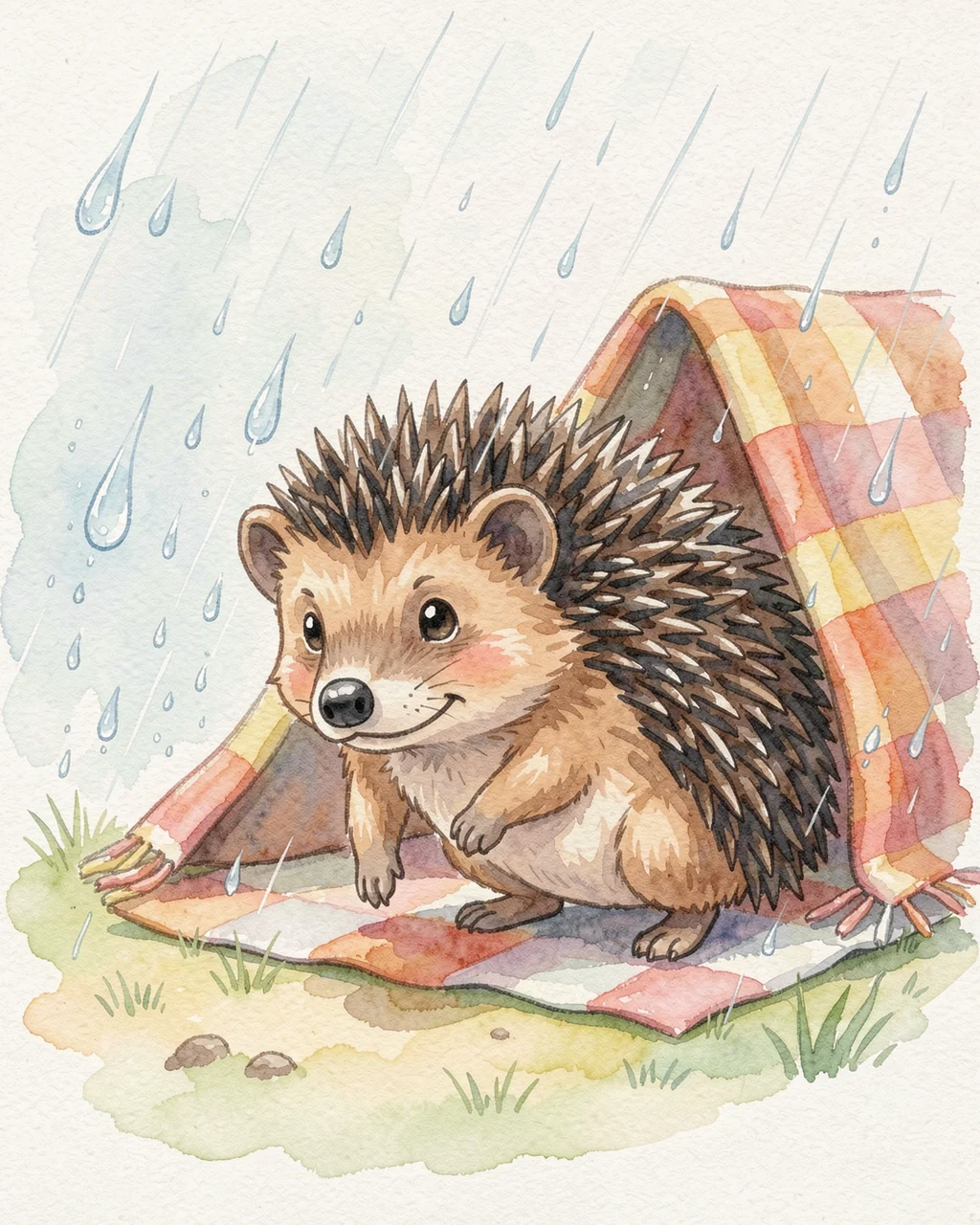
The handkerchief bridge held the blanket tight. The tent roof rose into a proper little mountain. Wisp placed the flashlight back on its bowl, moved the biscuits to a dry corner, and opened the entrance just wide enough to see the rainy window. “Welcome, River Rain,” he said. Outside, drops rushed down the glass. Inside, golden trees shone over Pillow Peak.
6 / 7
Wisp followed his pretend map three times. He crossed Rug River by hopping from blue swirl to blue swirl. He climbed Pillow Peak, where the air smelled of feathers. He visited the window waterfall and bowed to the racing drops. Each time he returned to camp, he ate one careful bite of biscuit and listened to the rain telling watery stories in its busy little voice.
7 / 7
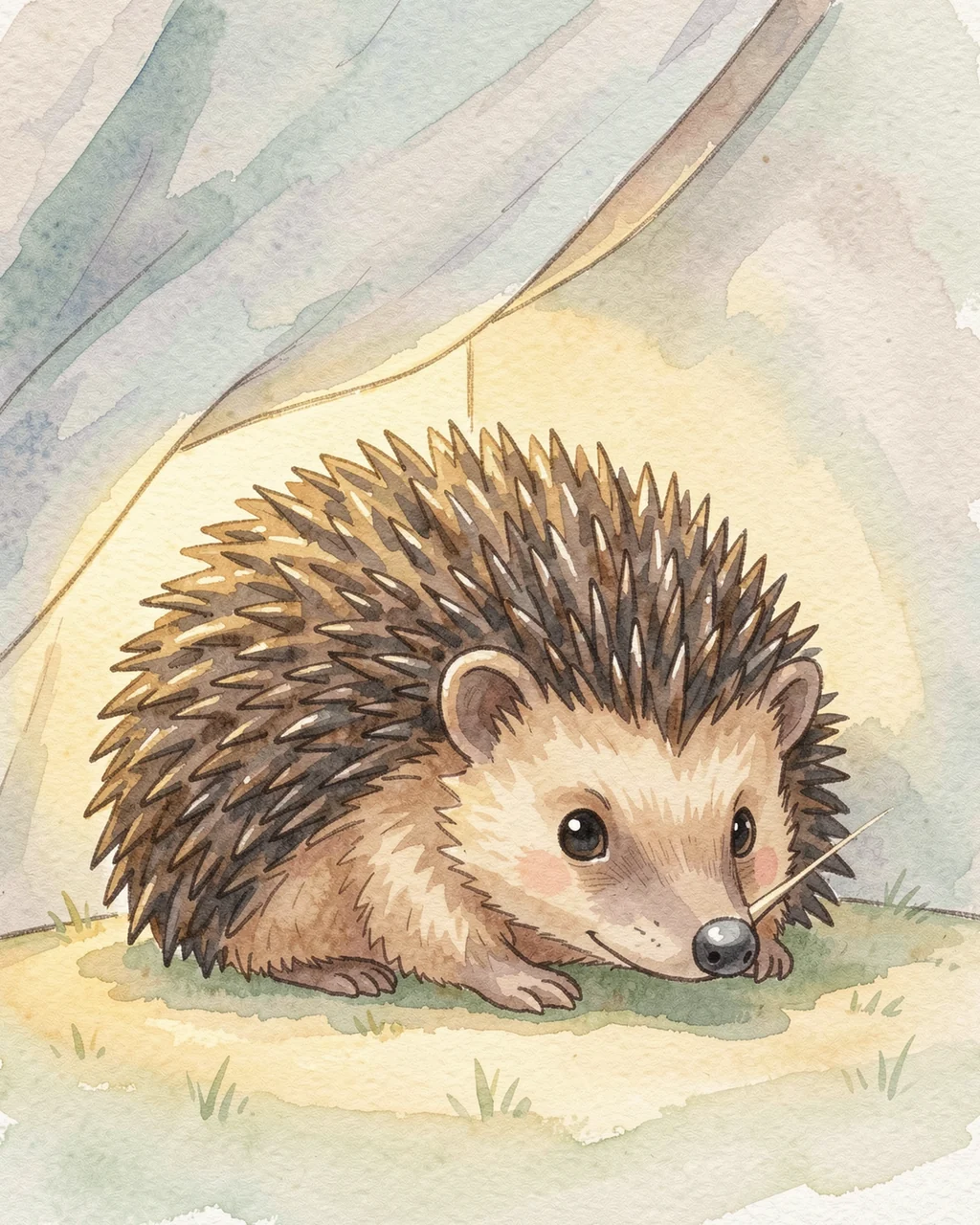
By the time the clouds began to thin, the room had not changed back completely. The armchair was still a cliff if Wisp looked at it sideways, and the blue rug still had a river hiding in it. He curled beneath the steady blanket roof, silver nose warm in the flashlight glow, while the last raindrops tapped politely at the window. His campsite was ready for whatever journey came next.
After the story The big idea and questions to talk through together Пусть приключение закончится мягким и тёплым поворотом.
The big idea
Пусть приключение закончится мягким и тёплым поворотом.
Emotional goal
A rainy day indoors
A rainy afternoon turns into an adventure when a small hedgehog builds a tent out of blankets.
A question to discuss
После чтения спросите ребёнка: какая часть истории была самой тёплой или смелой сегодня?
Questions after reading
- Какая сцена понравилась тебе больше всего и почему?