 TuckBook
Bedtime stories
TuckBook
Bedtime stories
The Missing Acorn Door
When Cobweb accidentally smashes Pip’s tiny house, she works hard to mend every broken piece. But the most important repair comes when she finds the courage to apologize.
✦ Story pages
5 minutes of reading
The Missing Acorn Door
1 / 4
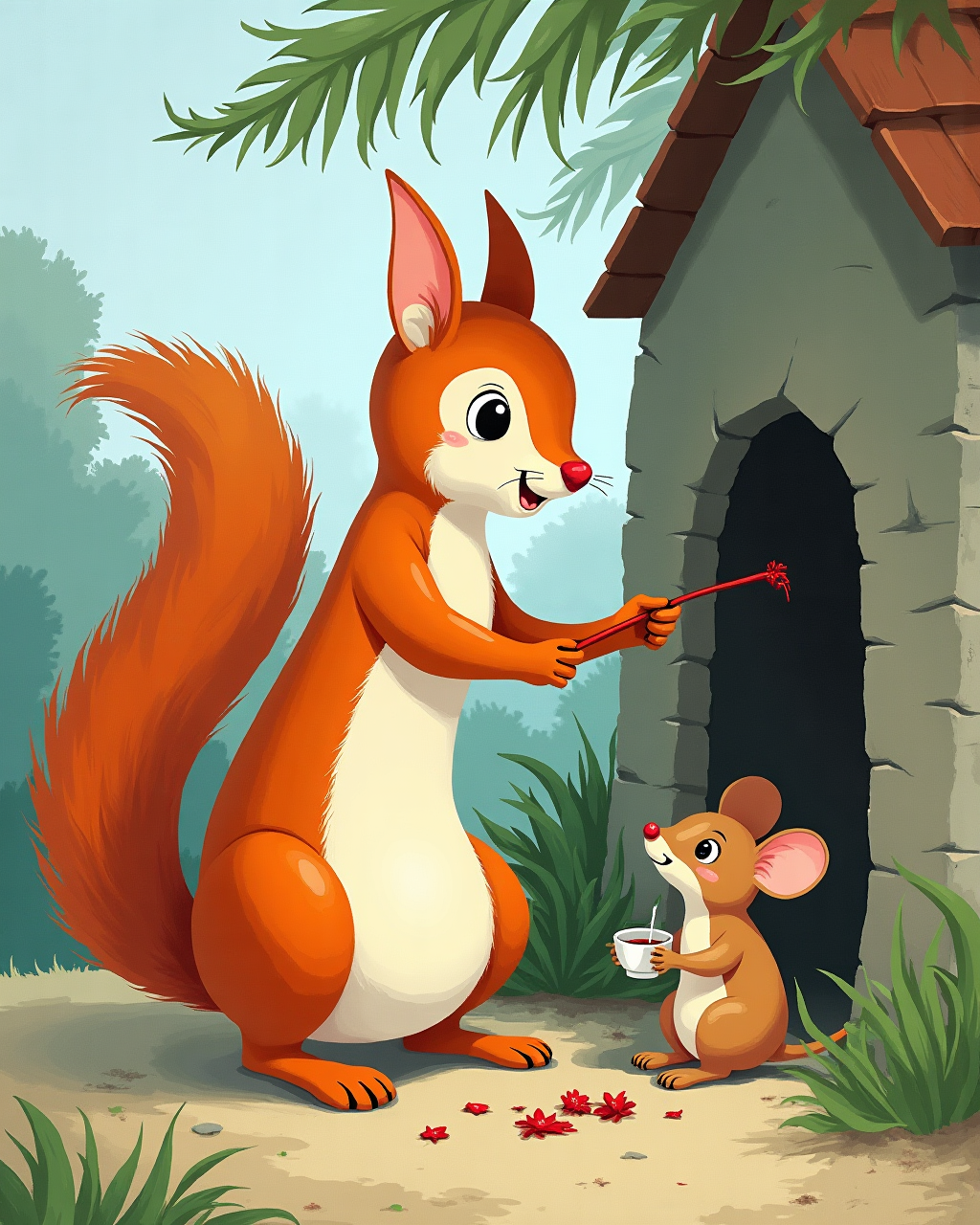
Cobweb the squirrel shoved the biggest walnut she had ever found down the hill. “Roll, Walnut! Roll!” she cried. The walnut bounced off a root, sprang over a mushroom, and thumped straight into Pip’s little house beneath the fern. The house gave a sad crunch. Its acorn door flew off, its bark roof tipped sideways, and one round blue window landed in a puddle of clover tea.
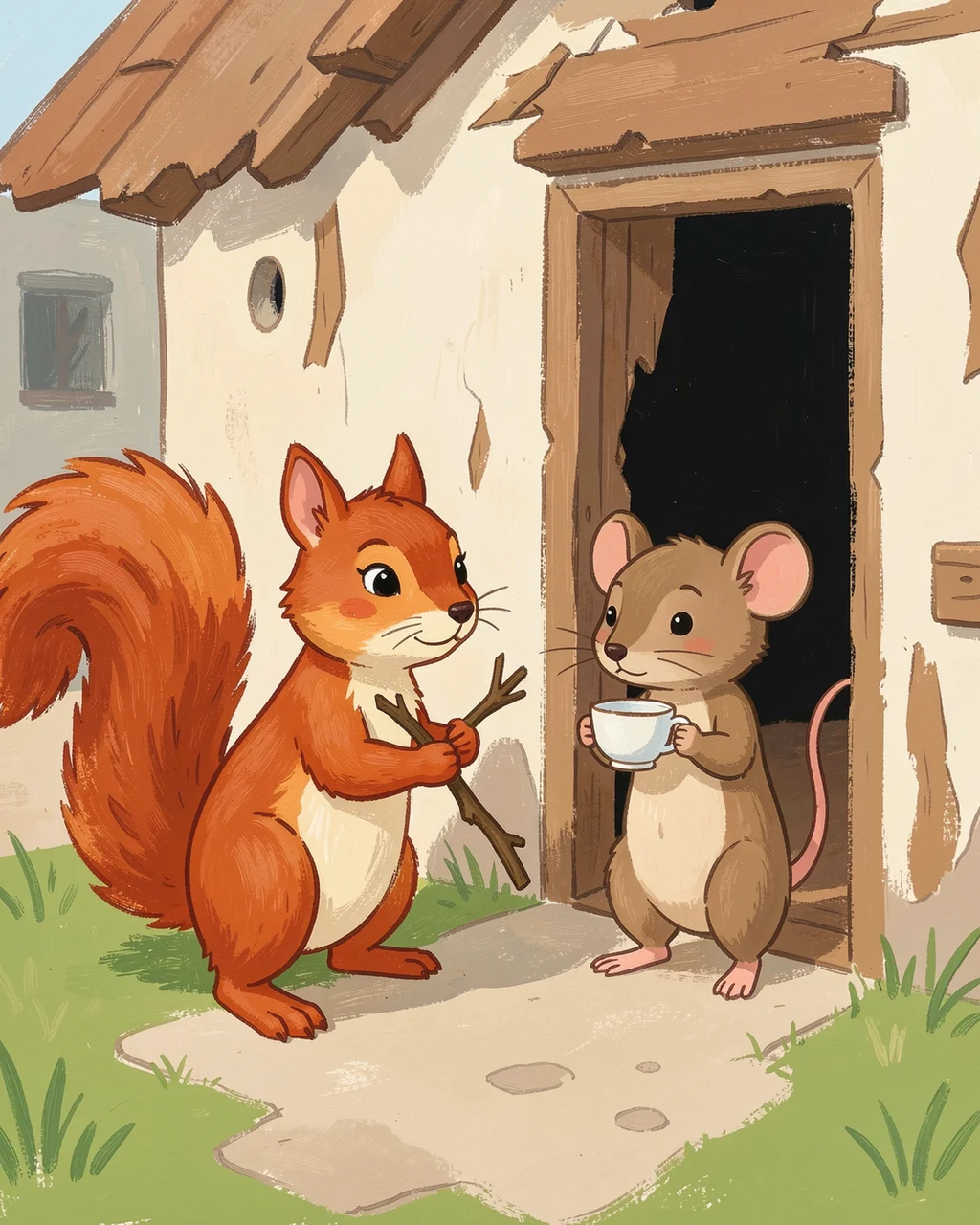
Pip the field mouse stood in the doorway-shaped gap, holding his teacup. He did not shout. That was worse. Cobweb’s paws went stiff around a twig. “I can fix it!” she squeaked, before Pip could say anything. Then she darted away so fast that three fern fronds wobbled after her.
First Cobweb fetched roof bark from the old stump, choosing the curled pieces that shed rain like duck feathers. She carried them one at a time, tucked under her chin. Next she collected sticky red glueberries from the bramble patch. A sleepy beetle pointed her to a fallen strip of silver birch bark for the wall. Cobweb piled everything beside Pip’s house and got to work.
All morning she patched. She pressed bark into place with glueberry juice. She tied the roof with grass-thread, knotting it with her teeth. When the blue window would not stay put, she made a frame from two bendy twigs. Pip sat under a leaf nearby, watching his teacup slowly collect little drops from the crooked roof.
2 / 4
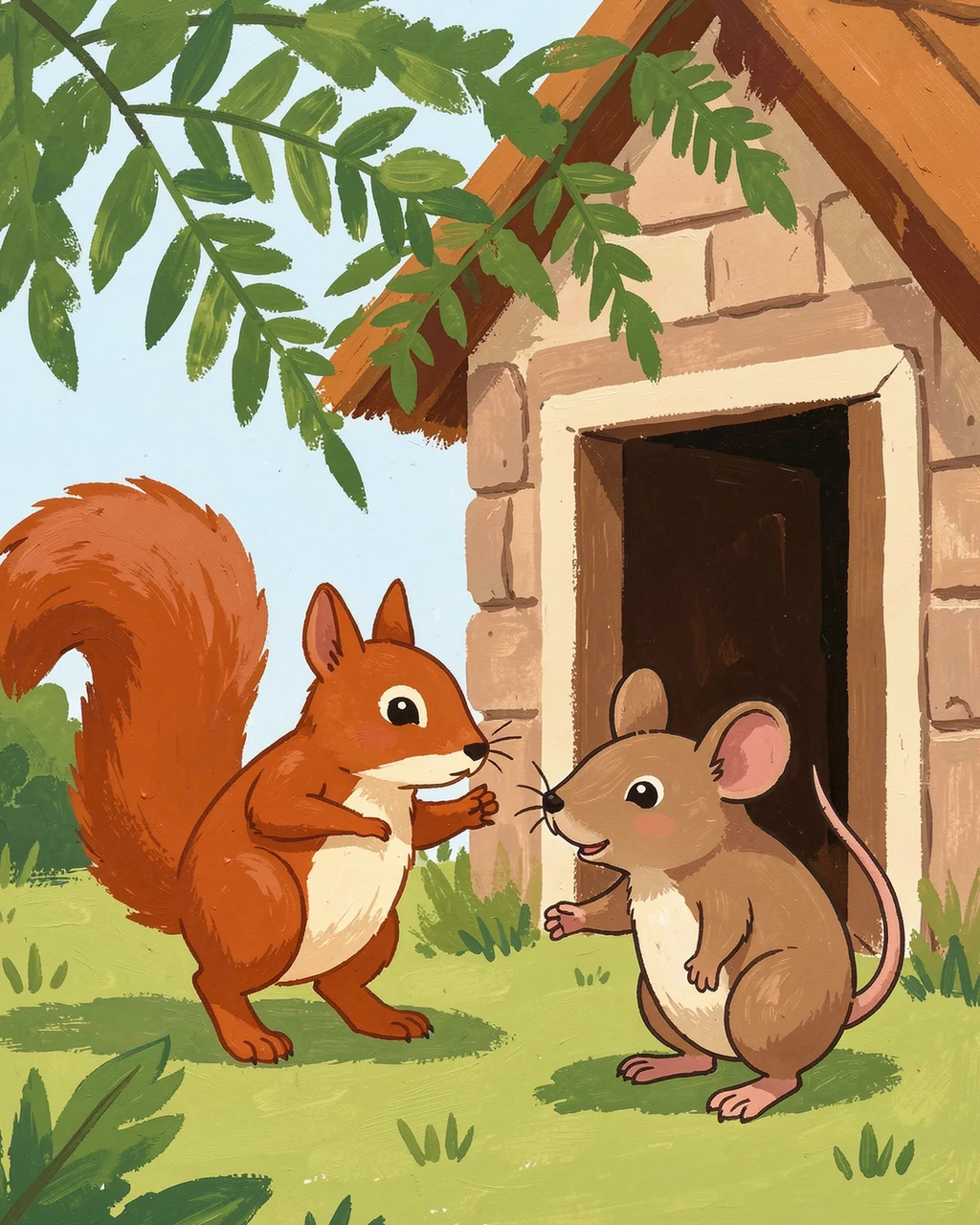
By lunchtime, the house stood up again, though it leaned toward the fern as if listening for gossip. Cobweb stepped back, proud for exactly one blink. Then she saw the empty doorway. “The acorn door!” she gasped. Without it, Pip’s house was a house with its mouth open. And the door had bounced away with the walnut.
Cobweb followed the trail: a walnut dent in the moss, a scuff across a pebble, then a streak of acorn-shell dust by the stream. At the stream she found the door caught in a whirl of waterweed, spinning round and round like a tiny boat wheel. She could have leaped for it, but the stones were slippery. Instead, Cobweb dragged a long reed across the water, hooked the little door through its round handle, and pulled it safely to shore.
3 / 4
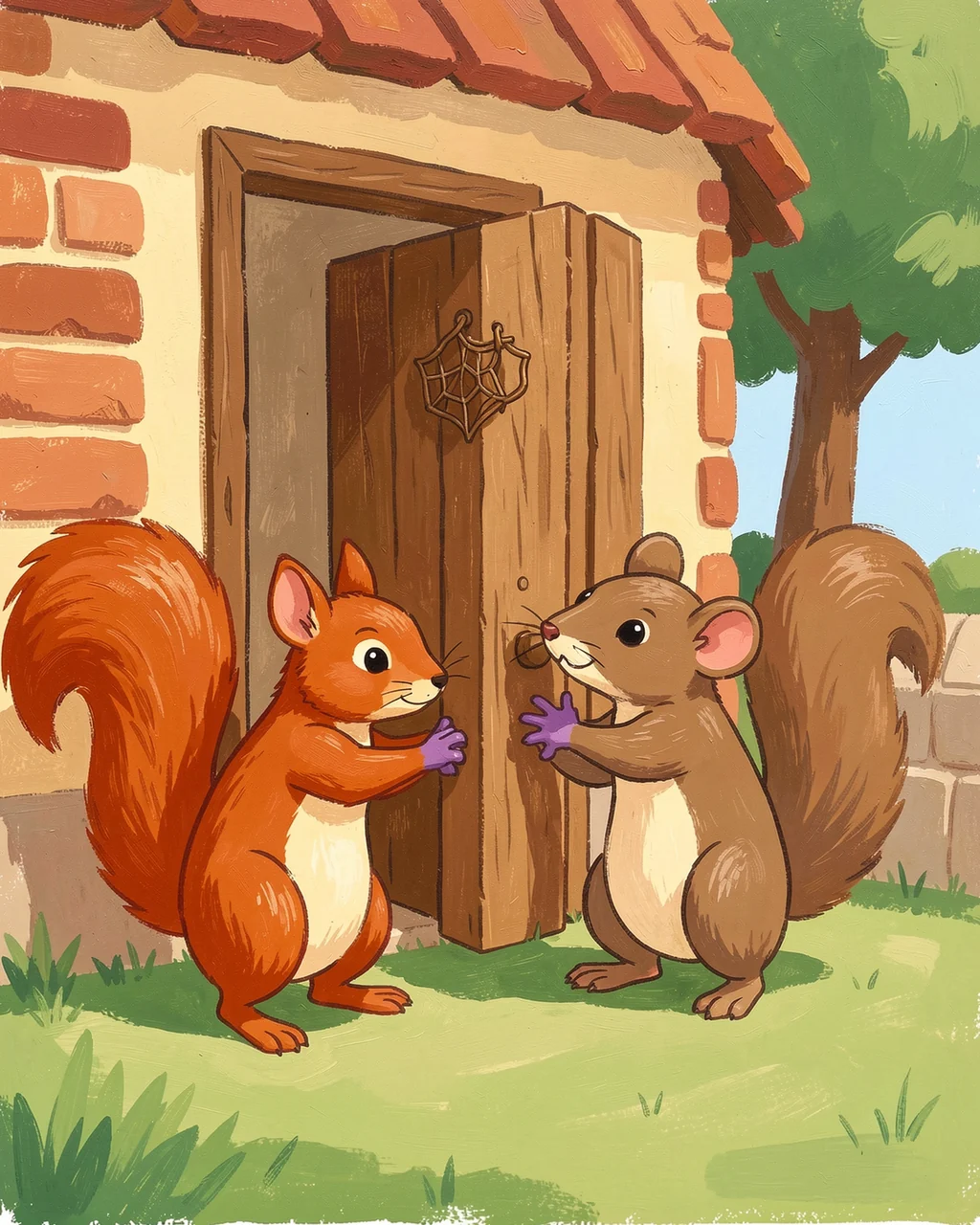
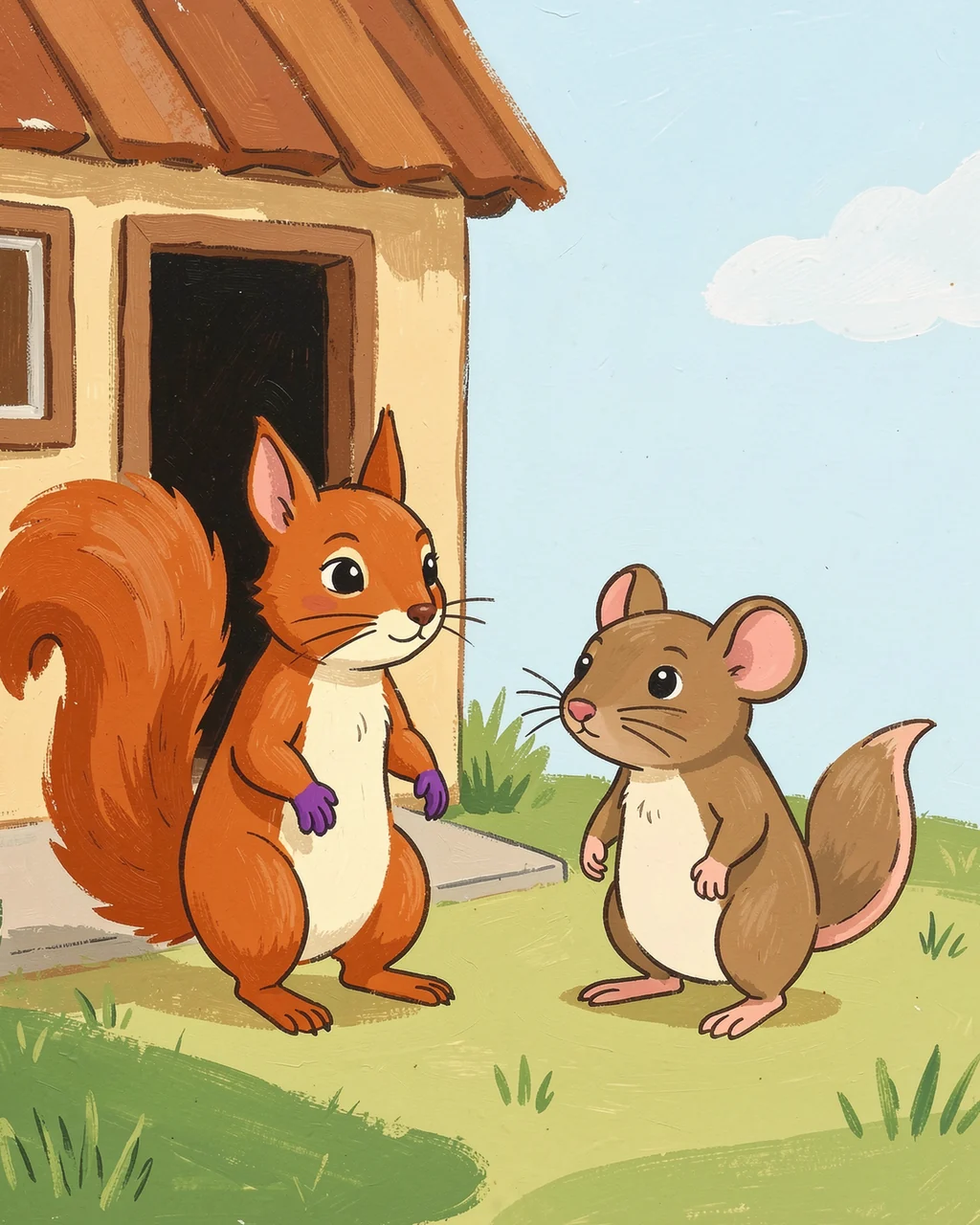
The door had a crack across it. Cobweb hurried back and rubbed glueberry juice into the crack. She held the two halves together until her paws were purple and sticky. At last the door clicked neatly onto its hinge. Pip pushed it open. He pushed it shut. It made a fine, important little squeak.
4 / 4
Cobweb waited for Pip to smile. He did not. He looked at his mended roof, his rescued window, and his acorn door. Then he looked at Cobweb. Her busy paws suddenly had nowhere to go. She could fetch a prettier pebble for the doorstep. She could paint stripes on the wall with blackberry juice. She could work until the moon came up. But none of that was the thing sitting, large and heavy, behind her teeth.
Cobweb lowered her head. “Pip,” she said, “I am sorry I broke your house.” Pip’s whiskers lifted. “Thank you for telling me,” he said. Then he opened the acorn door wide. “Would you like to help me drink the clover tea before it gets cold?” Cobweb sat beside him on the mended doorstep, purple-pawed and sticky, while the little house gave one pleased squeak.
After the story The big idea and questions to talk through together Пусть приключение закончится мягким и тёплым поворотом.
The big idea
Пусть приключение закончится мягким и тёплым поворотом.
Emotional goal
Saying sorry
A squirrel accidentally breaks a friend's little house and spends all day working up to one simple word.
A question to discuss
После чтения спросите ребёнка: какая часть истории была самой тёплой или смелой сегодня?
Questions after reading
- Какая сцена понравилась тебе больше всего и почему?